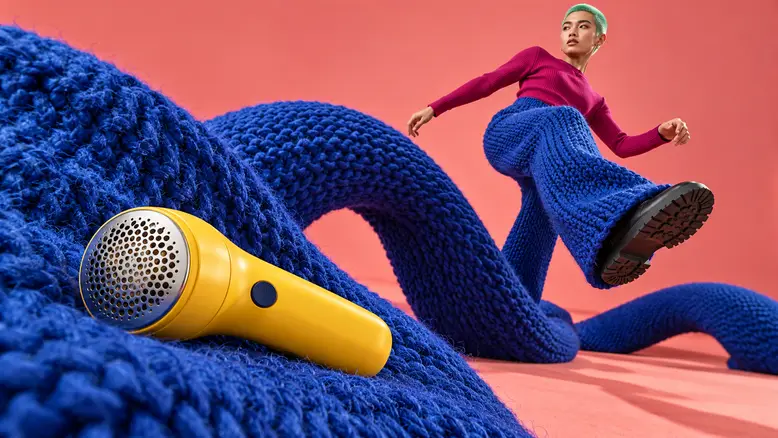
Plan three opening hooks by holding the product, message, middle, and ending steady while changing how the ad begins. Build one opening around a problem, one around an action, and one around a reveal. Generate only the new footage each version needs, then compare the complete edits. Three different promises would create three different ads, making the opening harder to evaluate.
What changes when you change the hook?
A hook gives the viewer a reason to continue. That reason can come from the first picture, the first words, a sound, or a relationship between them. It should lead into the same message the rest of the ad can deliver.
This original creative plan uses a yellow handheld fabric shaver, a cobalt knitted garment, and Rin, an adult presenter with a mint buzz cut. The product has a circular perforated steel head and one navy button. The creative exercise explores three openings for one demonstration; it is not a report of measured cleaning performance or ad results.
| Opening route | First visual question | Connection to the main edit |
|---|---|---|
| Problem | What are these pills on the knit? | Move toward a product-use explanation |
| Action | What is the hand about to do? | Continue the same careful demonstration |
| Reveal | What is beneath the folded cloth? | Introduce the same yellow device |
Keep the promise proportional to the evidence. Showing pills introduces a material condition. Showing an invented spotless result would imply an outcome. If that outcome matters to the sale, use an accurate demonstration with support for the claim, rather than assuming a generated transformation proves it.
Organize the variants in PixTV
Keep the approved product and character references with the three opening briefs. Use image generation to compare starting compositions before spending on motion. The references should fix the product design; the briefs should explain how the openings differ.
Use video generation for the additional shots the plan requires. Assemble each opening with the same approved middle and ending through the video editing workspace, using its available controls. A naming system can organize this work without assuming a dedicated batch-testing feature.
Start with one approved master edit
Make a complete ad before expanding it. The master should introduce the product, explain the relevant action, and finish with one next step. Mark where the opening ends and the shared middle begins. That handoff is the part every variant must reach coherently.
For the fabric-shaver concept, the shared handoff could be a neutral close view of the device beside the knit. Each opening can lead to that same view without requiring a different product, setting, or claim. If an opening needs a new middle to make sense, revise the opening or treat it as a separate creative concept.
Keep the product and proposition fixed
Save a short approval note: yellow body, round steel head, navy button, the same garment, and the same factual product description. Keep any offer and final destination stable as well. The product video guide covers the underlying shot preparation.
Do not vary the product color just to make the openings look different. That introduces another decision for the viewer and creates more product states to inspect. Visual variety should come from framing, timing, and the first event.
Opening A: begin with the problem
Frame a small area of visible pills on the blue knit, with the yellow device nearby. The viewer should recognize the material before the ad explains the intended use. A restrained line could be: “A closer look at the knit.”
Direct a small camera approach or a static hold. Avoid a dramatic fabric transformation in the opening. The shared middle can explain the product without asking the generated footage to prove a cleaning result.
Opening B: begin with an action
Show Rin's hand bringing the same device toward the garment. Begin slightly before contact so the viewer understands the relationship between hand, tool, and cloth. The short action needs a clear destination, not several unrelated gestures.
An example brief is:
Close shot of Rin's hand holding the yellow fabric shaver above cobalt knit. The hand lowers it slowly and pauses. Keep the steel head circular, the navy button visible, and the garment stable. Fixed camera, no fabric transformation.
Opening C: begin with a reveal
Place the device beneath a loose fold of blue cloth, then lift the fold to reveal it. Keep the reveal simple enough that the product is recognizable before the opening ends. A line such as “One small tool in the drawer” can introduce the object without inventing a result.
Match the last frame of the reveal to the shared middle: same device orientation, similar scale, and enough space to cut cleanly. A surprising first frame does not help if it strands the edit in the wrong position.
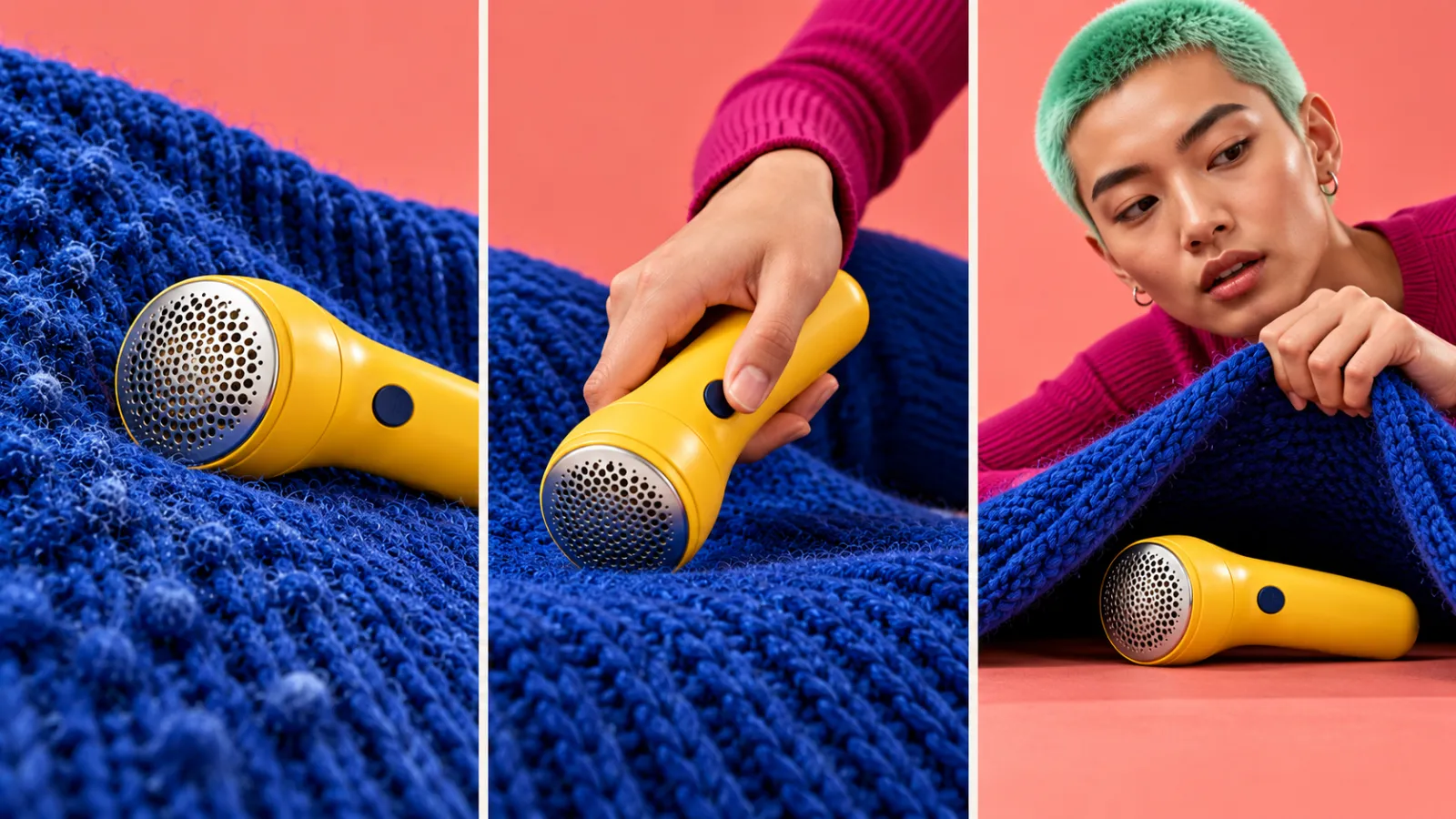
Three alternative opening plans. The panels are creative directions, not before-and-after evidence or performance rankings.
Control lighting before comparing the openings
Keep a consistent exposure and product color across the three versions. If the problem shot is dark and the reveal is brightly lit, an audience response may reflect visibility rather than the opening idea. Match the practical viewing conditions as closely as the materials allow.
Creative differences still need room to exist. A detail shot and a medium reveal will not have identical compositions. Hold the relevant message and production conditions steady while allowing the intended opening mechanism to change.
Keep the words and sound easy to trace
Make the first line part of the variant record. If the picture and wording both change, describe that version as a combined opening concept. To test wording alone, reuse the same footage and change only the words.
Likewise, keep the music and narration delivery stable unless they are the variables being explored. A louder sound or a different voice can change how the same first picture feels. Export a silent preview as an additional production check, not as a claim about how viewers will respond.
Make each version fit its final frame
Compose the first shot for the intended placement and check the actual preview. Keep the product, hand, and essential text clear of likely interface coverage. A horizontal review board is a planning aid; it is not the vertical ad master.
| Variant | Opening | Shared material | Final review question |
|---|---|---|---|
| A | Knit detail | Same middle and ending | Is the problem readable? |
| B | Hand approaching tool use | Same middle and ending | Is the action understandable? |
| C | Cloth lifting reveal | Same middle and ending | Is the product revealed in time? |
Choose the production route for the variable
| What changes | Work needed | What can stay |
|---|---|---|
| First line only | New recording or editable text | Existing opening footage |
| First picture | New image and possibly a new clip | Approved script and later shots |
| Cut timing | Another edit pass | All accepted footage |
| Presenter | New identity and continuity review | Product facts and overall structure |
This separation prevents unnecessary generation. If a cut is simply late, try moving it before asking the model for a new scene. Regenerate when the action, identity, or product itself cannot meet the plan.
Count additional work, not just finished versions
One master plus two alternate opening clips can produce three edits when the middle and ending are reusable. If each alternate requires three attempts, the extra production includes six generation attempts, plus assembly and review. This is an illustrative workload calculation, not a price or success-rate estimate.
Check the selected settings' displayed cost and include audio, references, and editor time. Version count and generation count are different numbers.
Review the complete ads before testing them
| Check | Pass condition |
|---|---|
| Product | Same design and color throughout |
| Promise | Opening and middle say compatible things |
| Handoff | No awkward jump into shared footage |
| Text and audio | Clear, readable, and supported |
| Record | Opening variable and source files identifiable |
Then compare actual distribution results under a suitable test plan. An editor's preference is useful creative feedback, but it is not evidence of better sales. Start the three opening plans in PixTV before multiplying the whole campaign.
Frequently asked questions
Is three the ideal number of hooks?
No. Three is a manageable exercise, not a performance formula. Real test size depends on objectives and resources. Start with an approved ad and enough material to compare the intended variable meaningfully.
Must an opening last three seconds?
No. Allow time to recognize the relevant object or event, then move forward. A detail may need less time than a reveal. Judge the handoff in the final frame at normal playback speed.
Can I change the price in one version?
Yes, but that changes the offer too. Record it as an offer comparison or combined concept, rather than an opening-only test. Keep the stated price accurate and the destination consistent with the advertisement.
Should every hook use a new presenter?
Only when the presenter is the variable. Otherwise keep the approved identity. A new person changes appearance, delivery, and body language together, making the independent contribution of opening wording or framing harder to identify.
Can AI predict which opening sells best?
Creative review can flag unclear actions and incompatible promises. It cannot establish sales performance without outcome data. Treat predictions as hypotheses, record test conditions, and compare actual results against the objective chosen before testing.
Can the versions share footage?
Yes, when the footage remains accurate for the same product concept. Sharing the approved middle and ending limits differences. Review each finished combination, because a valid clip can still create a confusing new transition.